The following brochure is provided for the particular benefit of landowners who might be interested in exploring the basic payment guidelines and policies of the project. Additional information may be requested from the Division of Conservation.
A project performance report is submitted annually to the USDA's Farm Service Agency and the Kansas Legislature as a condition of the program's authorization. The program has been operating for nine years. Past reports are available by contacting the Division of Conservation.
CREP Project Update - Rattlesnake Creek sub-basin area is added to accept enrollments!
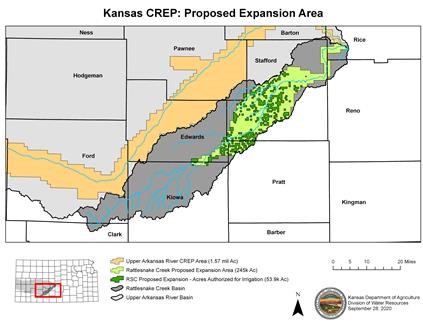
In a continuing partnership agreement, the State of Kansas (KDA) and USDA have agreed to revise and update the formal Memorandum of Understanding which outlines the legal and financial commitments for administering and implementing the Upper Arkansas River Conservation Reserve Enhancement Program (CREP). Each party willingly commits financial resources to support, maintain, strengthen and improve water and land conservation efforts through CRP enrollments in the basin.
This MOA provides significant revisions to the current agreement by 1) expanding the authorized project area to include portions of the Rattlesnake Creek Sub-Basin; 2) increasing the total allowable enrollment to 40,000 acres; 3) authorizing the CP-43 ‘Prairie Strips’ practice which can incorporate dryland farming in between approved conservation covers on certain soil types; and 4) further defines and increases the State of Kansas funding commitment for ‘direct payments to participants’ as ‘the USDA per-acre annual rental payment times 15 times 13.5 percent’.
Program Summary
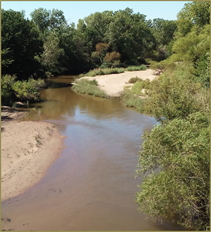
CREP in Kansas is a federal/state partnership created for enhancing water conservation efforts along the Upper Arkansas River (UAR) corridor from Hamilton County to Rice County. The Upper Arkansas River CREP has been officially approved and operating since 2007.
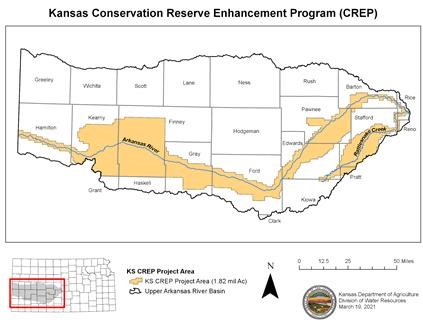
The Upper Arkansas River CREP is a voluntary, incentive-based program allowing producers to enroll eligible irrigated acres in targeted areas for 14–15 year contracts with FSA, permanently retire the associated state water rights on the enrolled acres, and establish an approved land cover (typically a native grass) on the same acreage. The producer receives an annual rental payment, plus additional cost-share opportunities for specific conservation practices from FSA, plus an upfront incentive payment from DOC.
The specific project goals are to achieve, to the extent practicable when fully enrolled, the following objectives:
- Enroll a maximum of 40,000 acres into CRP through this CREP in the project area (to be comprised of up to 37,000 irrigated cropland acres and up to 3,000 cropland acres of dryland center-pivot corners.
- Reduce the consumption of ground water for irrigation in the project area by 65,000 acre-feet of permitted water appropriations based on the enrollment of 37,000 irrigated acres.
- Reduce agricultural use of land that is unsuitable for dryland farming by enrolling 25,000 acres with a Wind Erodibility Index (WEI) of 134 or greater.
- Reduce the amount of annual soil lost to erosion by approximately 150,000 tons per year.
- Reduce the total annual use of electricity by 16 million kilowatt hours when full enrollment is met.
- Demonstrate ability to gradually transition from irrigation farming to non-irrigation farming through enrollment of 1,000 acres of land that has a Wind Erodibility Index of less than 134, and will be devoted to CRP practice CP43.
Eligible cropland conservation practices approved by FSA to meet the goals and objectives for this CREP project are as follows:
- CP2, Establishment of Permanent Native Grasses
- CP4D, Permanent Wildlife Habitat
- CP9, Shallow Water Areas for Wildlife
- CP21, Filter Strips
- CP23, Wetland Restoration
- CP23A, Wetland Restoration - Non-Floodplain
- CP43, Prairie Strips
As of Sept. 30, 2022, a total of 138 state CREP contracts on 23,430 acres have been approved by the State of Kansas. These contracts have resulted in the permanent retirement of 47,643 acre-feet of annual water appropriation on 169 water rights from 212 wells. The contracts represent a total of $1,669,373 in one-time state sign-up payments to producers over the past 14 years.
Annual Progress: Although 284 new acres were added in Pawnee County, 2021 and 2022 were again very slow years for enrollments. However, significant progress was made on developing programmatic changes resulting in enhanced potential for 2023. USDA granted formal approval to expand the eligible project zone with the addition of the Rattlesnake Creek area and increased the allowable project cap to 40,000 acres. A new conservation practice, “CP-43 Prairie Strips”, which can incorporate dryland farming in between approved conservation covers on certain soil types, was also approved. As a result of changes in the 2018 Farm Bill, the State of Kansas agreed to provide a much higher sign-up incentive payment to landowners — another significant change that was formalized in a revised and updated MOU between USDA and the State of Kansas to become effective October 1, 2021.
In 2022, FSA approved updated irrigated rental rates which are now some of the highest in project history, at $148 - $212 per acre depending on geographic location. The Division of Conservation’s upfront signing incentive payments have also been substantially raised and will be approximately $47,952 - $68,688 per quarter section depending on location.
Below is a recent press release link about our CREP project. It followed a Western Kansas field tour by USDA’s FSA Administrator Zach Ducheneaux on June 6, 2022.
USDA and State of Kansas Continue Conservation Successes With the Upper Arkansas River CREP
The Kansas Upper Arkansas River CREP project is the subject of an article featured on USDA’s Economic Research Service website entitled “Amber Waves”. It is a summary of a research project drawn from the following publication by A. B. Rosenberg entitled “Targeting of Water Rights Retirement Programs: Evidence from Kansas” which recently appeared in the American Journal of Agricultural Economics. The focus of the research is a cost/benefit analysis of our CREP project as a water conservation tool and provides a very favorable evaluation of the program results to date. It is quite easy to read for the highpoints and can be viewed at this address:
https://www.ers.usda.gov/amber-waves/2020/october/incentives-to-retire-water-rights-have-reduced-stress-on-the-high-plains-aquifer/
Program Update – August 2, 2023
As a result of the 2022 WTAP enrollment, one irrigation water right located within the City of Leoti target area was permanently retired at a bid price of $1,995.00 per ac-ft of Historic Consumptive Water Use (HWCU), a total cost of $74,726.72. The water right authorized two irrigation wells for 297 acre-feet on 148.6 acres (37.457 ac-ft HCWU). An additional sponsorship of $30,000 forwarded through Playa Lakes Joint Venture significantly contributed to the final execution and success of this mutual agreement. As a result, the landowner will receive a total payment of $104,726.72 for the voluntary retirement of the water right.
The amount of irrigation water right retirement in the GRASP project area now totals 1,150 acre-feet of annual water appropriation (151.357 acre feet HCWU).
Another 2023 WTAP enrollment will be held October 1 - November 15
Updated 2023 announcements and application materials are available here:
2023 WTAP Enrollment Notice - Wichita and Greeley Counties
2023 WTAP Enrollment Application Form
2023 WTAP Water Right Reduction Application Form
2023 WTAP Water Right Dismissal Application Form
* * * * * * * * * * * * *
A new WTAP target area was recently adopted in Greeley and Wichita counties effective 2021.
Chief Engineer's GMD #1 Designation Order
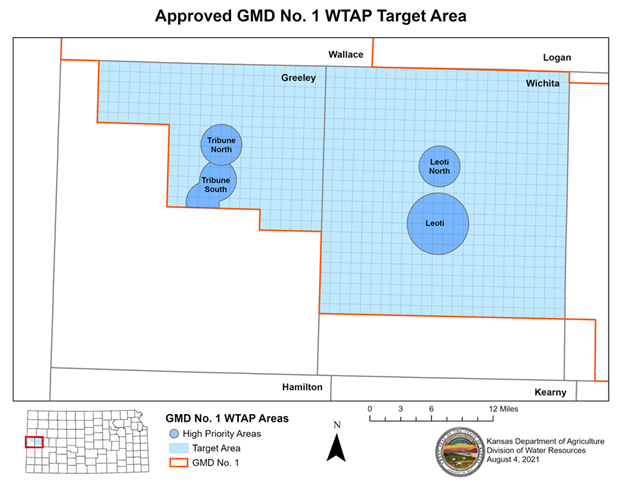
As a result of the 2021 enrollment, DOC accepted a bid of $227,810 to voluntarily dismiss three irrigation water rights authorizing 853 acre-feet per year on 420 acres from two wells. The net value of historic consumptive water use which has been permanently retired from the Greeley County target area near the City of Tribune municipal well fields is 113.9 acre-feet.
As a result of the 26 approved applications to date, 32 irrigation wells and 5,602 irrigated acres have been voluntarily dismissed in the process since 2007. A total of $3,820,219 in state funds have been expended in return for the permanent retirement of 7,942 acre-feet of annual water appropriation rights and 2,663 acre-feet of HCWU in these targeted regions at an average cost to the State of Kansas of $1,437 per acre-foot.
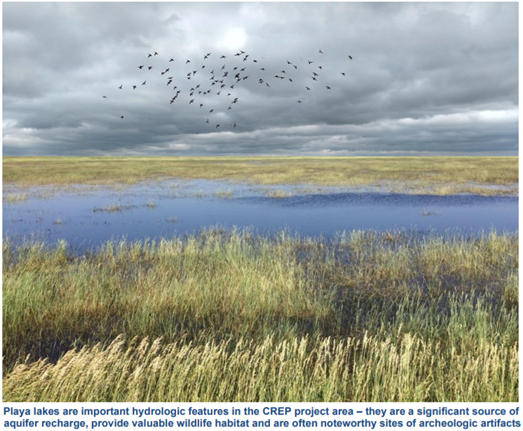
This WTAP enrollment is part of the larger Groundwater Recharge and Sustainability Project (GRASP). GRASP is a coordinated effort between the Natural Resources Conservation Service and several state and local partners to provide enhanced financial incentives for implementing water conservation and playa restoration practices in Greeley and Wichita counties.
Groundwater Recharge and Sustainability Project (GRASP) Press Release
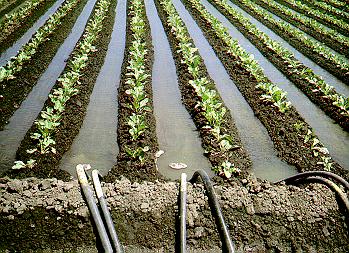
Water Right Transition Assistance Program Benefits Landowners and Water Resources
WTAP is a voluntary, incentive-based program that permanently retires privately held irrigation water rights in exchange for payment by the State of Kansas. It is intended to help restore aquifers and recover stream flows in critically depleted target areas. The 2022 Kansas Legislature extended WTAP until June 30, 2032 based on past results of the initial pilot project started in 2007 and the first 10 year program started in 2012.
The target areas currently designated include Rattlesnake Creek Sub-basin, Prairie Dog Creek Basin, and six “High Priority Areas” of Northwest Kansas Groundwater Management District No. 4. And added just recently - four high priority areas in the Western Kansas Groundwater Management District No. 1 in Wichita and Greeley counties.
WTAP bids cannot exceed $2,000 per acre-foot of the Historic Consumptive Water Use as calculated over the last ten years of actual annual water use of the water right(s) proposed for acceptance. Applications to accept partial water rights can also be considered. The award of WTAP grants for water right retirements is based on a competitive bidding process.
Applications which propose a financial contribution from a local entity may increase the priority of an application.

Water Right Transition Assistance Program Enrollment
For more information about WTAP enrollment opportunities, please contact Steve Frost at steve.frost@ks.gov or (785) 564-6622.